


 Cart
Cart
 sales@molnova.com



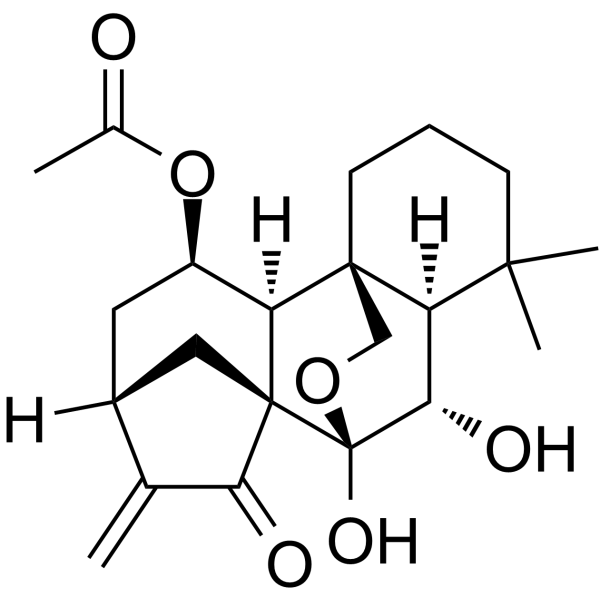
Longikaurin E
CAS No. 77949-42-9
Longikaurin E( (-)-Longikaurin E )
Catalog No. M27336 CAS No. 77949-42-9
Longikaurin E is a therapeutic agent for pancreatic cancer. It is isolated from Isodon adenolomus.
Purity : >98% (HPLC)
 COA
Datasheet
HNMR
HPLC
MSDS
Handing Instructions
COA
Datasheet
HNMR
HPLC
MSDS
Handing Instructions
| Size | Price / USD | Stock | Quantity |
| 5MG | 387 | Get Quote |


|
| 10MG | 581 | Get Quote |
|
| 100MG | Get Quote | Get Quote |
|
| 200MG | Get Quote | Get Quote |
|
| 500MG | Get Quote | Get Quote |
|
| 1G | Get Quote | Get Quote |
|
Biological Information
-
Product NameLongikaurin E
-
NoteResearch use only, not for human use.
-
Brief DescriptionLongikaurin E is a therapeutic agent for pancreatic cancer. It is isolated from Isodon adenolomus.
-
DescriptionLongikaurin E is a therapeutic agent for pancreatic cancer. It is isolated from Isodon adenolomus.
-
In Vitro——
-
In Vivo——
-
Synonyms(-)-Longikaurin E
-
PathwayOthers
-
TargetOther Targets
-
RecptorFarnesyl transferase (FTase)|GGTase I
-
Research Area——
-
Indication——
Chemical Information
-
CAS Number77949-42-9
-
Formula Weight390.476
-
Molecular FormulaC22H30O6
-
Purity>98% (HPLC)
-
Solubility——
-
SMILES[H][C@@]12[C@@H](C[C@@H]3C[C@]1(C(=O)C3=C)[C@@]1(O)OC[C@]22CCCC(C)(C)[C@@]2([H])[C@@H]1O)OC(C)=O
-
Chemical Name——
Shipping & Storage Information
-
Storage(-20℃)
-
ShippingWith Ice Pack
-
Stability≥ 2 years
Reference
1.Kazi A, et al. Dual farnesyl and geranylgeranyl transferase inhibitor thwarts mutant KRAS-driven patient-derived pancreatic tumors. Clin Cancer Res. 2019 Jun 21.
molnova catalog



related products
-
Podophyllotoxone
Podophyllotoxinone a natural compound found in Dysosma versipellis shows inhibitory activity against L1210 leukemia and KB cells in vitro.
-
1,3-Dimethoxybenzene
1,3-Dimethoxybenzene (Resorcinol dimethyl ether) is a dimethoxybenzene analog from German hazelnuts that is an intermediate in the synthesis of other compounds.
-
POPG sodium salt
POPG sodium salt is a phospholipid with a negative charge and is a component of biological membranes. It can be used to study the function of biological membranes.
